

Key Takeaways
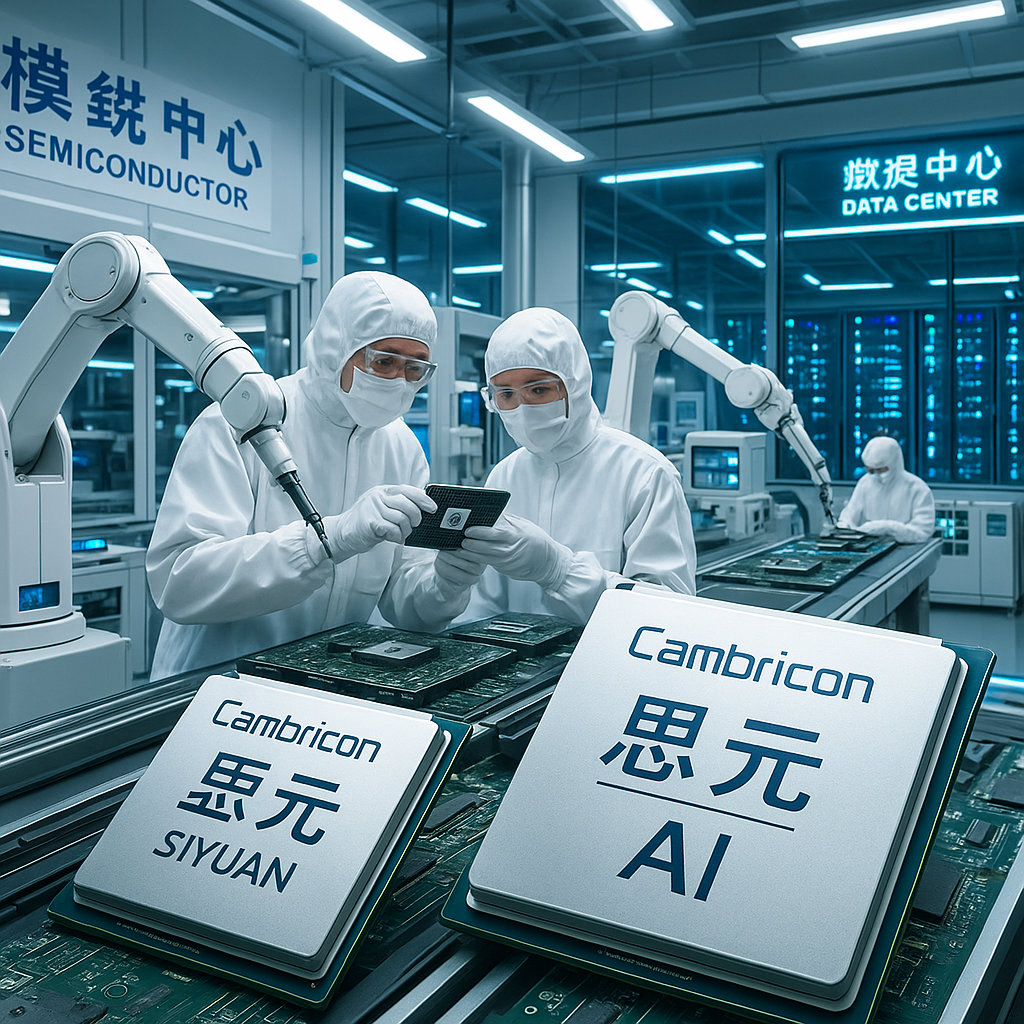
- Cambricon to triple chip production: The company aims to increase AI chip manufacturing threefold in 2024 to meet rising market demand.
- Direct challenge to Nvidia: Cambricon is positioning itself as a major competitor to Nvidia, seeking a larger share of the AI accelerator market.
- Focus on domestic market amid export controls: Faced with tightening US restrictions on advanced chip exports to China, Cambricon is boosting production to serve local tech firms and AI startups.
- Shanghai tech forum announcement: Executive leadership outlined the expansion strategy during a major industry event in Shanghai.
- Next milestone: New product lines launching Q3 2024: Cambricon confirmed it will introduce next-generation AI hardware designed to compete on performance and cost.
Introduction
Cambricon Technologies announced Thursday at a Shanghai tech forum that it will triple its AI chip production by the end of 2024. This directly challenges Nvidia’s leadership in the AI hardware market. The strategic expansion seeks to meet growing demand for cost-effective, locally produced chips amid ongoing US export restrictions. At the same time, it positions Cambricon for major upcoming product launches.
Cambricon’s Ambitious Production Plan
At the Shanghai tech forum, Cambricon Technologies detailed its intention to triple AI chip manufacturing capacity by the end of 2024. The company plans to increase monthly output from 200,000 units to approximately 600,000 units to satisfy strong domestic demand.
The expansion will occur in three phases, with a 30% capacity increase expected by the second quarter of 2024. CEO Chen Tianshi stated that further boosts are scheduled for the third and fourth quarters, aiming for the 600,000-unit final target.
Chen emphasized that demand for AI computing in China is surpassing available supply. He also confirmed that Cambricon has secured the funding and technological resources necessary to meet its accelerated timeline.
Un passo avanti. Sempre.
Unisciti al nostro canale Telegram per ricevere
aggiornamenti mirati, notizie selezionate e contenuti che fanno davvero la differenza.
Zero distrazioni, solo ciò che conta.
 Entra nel Canale
Key to this expansion: bolstered relationships with semiconductor fabrication partners and investments in advanced testing capabilities. The company has allocated about $420 million specifically to enhance manufacturing infrastructure.
Product Portfolio Expansion
Alongside increased production, Cambricon plans to introduce three new AI chip models tailored for various computing needs. The 7nm Siyuan 590 processor targets data centers, while the energy-efficient Siyuan 220 is aimed at edge computing.
The highlight is the Siyuan 670, a high-performance chip designed for complex generative AI tasks, including chatbots and image generation. Early performance figures presented at the forum suggest the chip’s computational efficiency is within 30% of similar Nvidia offerings.
Chen noted that the new chips feature an upgraded architecture, improving power efficiency by 40% compared to the previous generation. Improvements include redesigned memory controllers and enhanced parallel processing to deliver more AI compute per watt.
This diverse portfolio reflects Cambricon’s strategy of addressing different segments of the AI market, rather than focusing solely on the highest-performance tier. The approach may allow the company to gain footholds in specialized applications.
Taking on Nvidia: The New Challenger
Cambricon’s expansion aligns with the tightening of US export controls, which have limited Nvidia’s ability to sell advanced AI chips in China. Cambricon is positioning itself as a domestic alternative prepared to fill the gap left by these restrictions.
While executives acknowledged Nvidia’s current lead in performance, they stressed Cambricon’s focus on accessibility and optimization for local requirements. Chief Technology Officer Zhou Duo stated that their solutions are being developed specifically for China’s AI ecosystem and priorities.
Industry analysts warn that challenges remain for Cambricon. Zhang Wei, an analyst at China Renaissance Securities, highlighted that Nvidia’s longstanding investment in software and ecosystem support gives them an entrenched advantage.
Competition now extends beyond hardware and into areas of software compatibility, developer tools, and enterprise services. In response, Cambricon has reportedly doubled its software engineering team to strengthen programming frameworks and compatibility.
Market and Financial Implications
Following the announcement, Cambricon’s stock rose 8.4%, reflecting investor optimism toward its growth strategy. The company reported a 42% year-over-year revenue increase in the latest quarter, largely driven by domestic sales.
The production expansion will require an estimated $1.2 billion over the next 18 months. Cambricon plans to use cash reserves, a recent $380 million private placement, and partnerships with government-backed investment funds for financing.
Chief Financial Officer Li Wei said that the expansion will help the company realize economies of scale and potentially reduce unit production costs by up to 25% at full capacity.
Market research firm IDC projects that China’s AI chip market will reach $11.8 billion by 2025, presenting a considerable opportunity for domestic manufacturers. Cambricon currently holds around 8% market share in China’s AI accelerator segment, with ambitions to triple this figure within two years.
China’s investment in automation
Un passo avanti. Sempre.
Unisciti al nostro canale Telegram per ricevere
aggiornamenti mirati, notizie selezionate e contenuti che fanno davvero la differenza.
Zero distrazioni, solo ciò che conta.
Entra nel Canale
Industry Context and Challenges
Cambricon’s aggressive growth reflects a broader national push for technological self-reliance in China, with significant government support channelled toward the semiconductor industry. The country’s latest five-year plan prioritizes domestic AI chip development.
Notwithstanding, manufacturing obstacles persist. Unlike Nvidia, which partners with TSMC for leading-edge chip fabrication, Cambricon currently uses less advanced processes. Its newest chips are built with 7nm technology, while international competitors employ 4nm or 5nm processes.
Liu Chang, professor of electrical engineering at Tsinghua University, observed that architectural innovation and specialized optimizations must compensate for this manufacturing gap. Focusing on China-specific workloads could help offset disadvantages.
Attracting AI developers to Cambricon’s ecosystem also poses a challenge. To address this, the company has launched expanded developer programs, including a $50 million fund for startups and partnerships with universities to train engineers on its technology.
Conclusion
Cambricon’s plan to triple AI chip output and introduce new processors signals a determined effort to strengthen China’s domestic supply chain under shifting global trade conditions. The expansion highlights both increasing local demand and the ongoing challenge of catching up with international technology leaders. What to watch: the results from the first capacity increase expected by Q2 2024, with further production phases scheduled through the end of the year.




Leave a Reply