

Key Takeaways
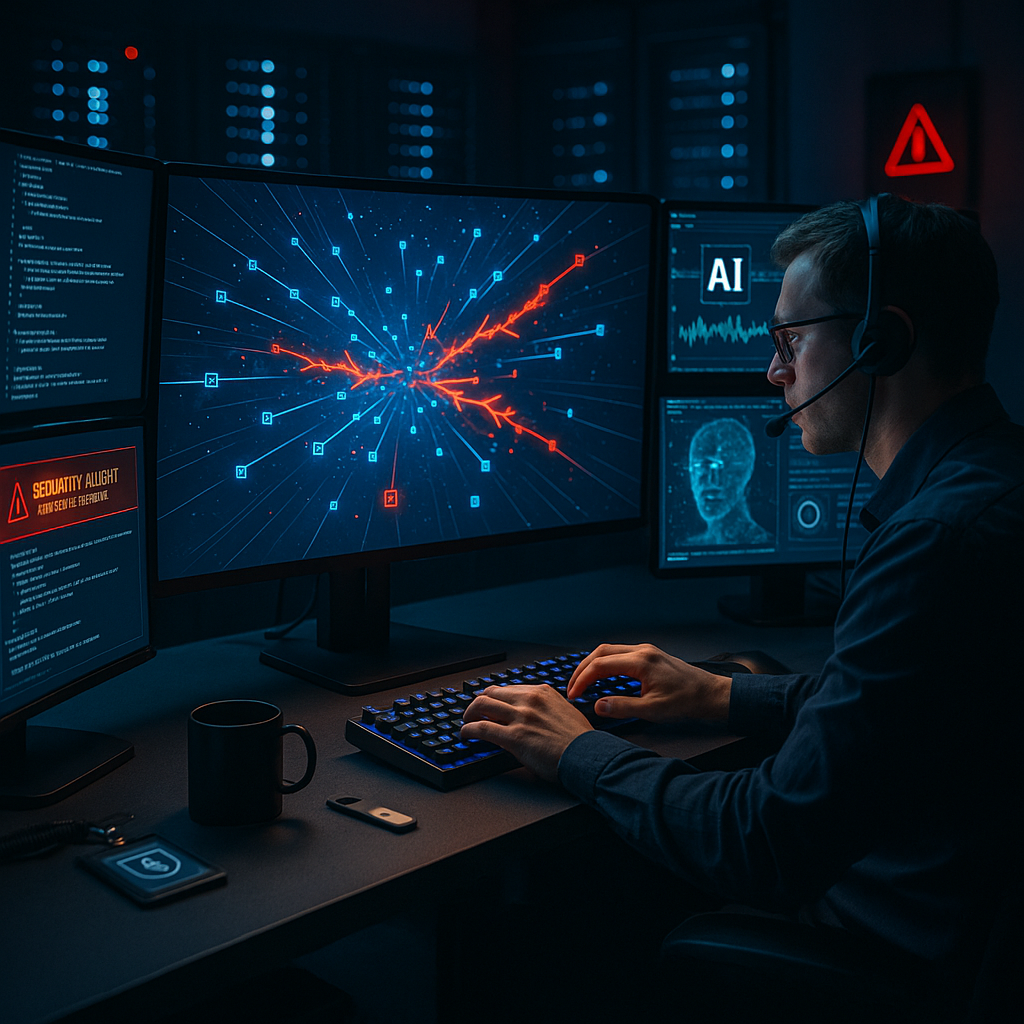
- AI-driven attacks outpace defenses: Researchers report that novel AI-powered cyber threats are bypassing traditional security tools at an unprecedented rate.
- Critical vulnerabilities exposed: Recent incidents revealed gaps in existing cybersecurity frameworks,* leaving sensitive data more vulnerable to exploitation.*
- Urgent call for smarter solutions: Experts urge tech companies to accelerate innovation in adaptive, AI-based security measures that can keep pace with rapidly evolving threats.
- Impacts span users and businesses: Both individuals’ personal information and enterprise systems are increasingly at risk, emphasizing the need for accessible, user-friendly security options.
- Industry response forthcoming: Major firms are expected to respond with new strategies, while regulators may push for updated cybersecurity guidelines in the coming months.
Introduction
Artificial intelligence is advancing more rapidly than current cybersecurity measures can defend against. Urgent warnings from top researchers released today back this up. Recent incidents show AI-powered threats sidestepping traditional safeguards, exposing both personal and business data to new risks. As innovation outpaces defense, the tech community faces mounting pressure to develop smarter, more adaptive protections for everyone navigating the digital world.
Latest Warnings from AI Security Researchers
AI-powered cyberattacks are evolving faster than defensive capabilities, according to a new report from the Cybersecurity and Infrastructure Security Agency (CISA). The agency documented a 78% increase in AI-augmented attacks targeting critical infrastructure in the first half of 2023.
The research highlights how machine learning algorithms now enable attackers to rapidly adapt to security countermeasures, sometimes within minutes instead of days or weeks. CISA researchers observed sophisticated AI systems automatically probing networks, identifying vulnerabilities, and adjusting attack strategies with no human intervention.
Dr. Elena Fortis, Chief AI Security Analyst at CISA, stated that the threat landscape is fundamentally shifting. She noted that traditional signature-based defenses cannot keep pace with attacks that evolve in real time and learn from each defensive action taken against them.
Un passo avanti. Sempre.
Unisciti al nostro canale Telegram per ricevere
aggiornamenti mirati, notizie selezionate e contenuti che fanno davvero la differenza.
Zero distrazioni, solo ciò che conta.
 Entra nel Canale
How AI Is Transforming Cyber Threats
Artificial intelligence has dramatically enhanced three key aspects of cyberattacks: speed, personalization, and evasion capabilities. Modern AI systems can generate convincing phishing campaigns tailored to specific organizations or individuals at scale, making detection significantly more difficult.
Attackers are now deploying machine learning models that continuously optimize their approaches based on success rates. According to the Stanford Internet Observatory, AI-driven phishing attempts achieve nearly triple the success rate of traditional methods, with some campaigns showing 60% higher conversion rates when targeting specific demographics.
A particularly worrying trend is the rise of “adaptive malware” that alters its code structure to evade detection while maintaining malicious functionality. Marcus Chen, principal researcher at Sentinel One, explained that these systems can fundamentally rewrite themselves while preserving harmful capabilities, making them more than superficially polymorphic threats.
Recent AI-Driven Attacks
The healthcare sector has recently become a primary target. In April, Boston Memorial Hospital suffered a major breach where an AI system systematically exploited vulnerabilities in the patient management system. Sensitive medical records for over 30,000 patients were exfiltrated, as the attacker adapted tactics to avoid detection for nearly three weeks.
Financial institutions face similar threats. Last month, Meridian Credit Union experienced an AI-driven attack that mimicked legitimate user behavior for months, slowly siphoning funds through thousands of micro-transactions designed to evade fraud detection systems.
Jayna Washington from the Financial Services Information Sharing and Analysis Center (FS-ISAC) emphasized the danger posed by the patience of these attacks. She pointed out that they blend in by learning normal behavior patterns rather than executing sudden, dramatic breaches.
Defense Gaps and Challenges
Current cybersecurity infrastructure has fundamental limitations against AI-powered threats. Many legacy systems rely on known patterns and signatures, which are inadequate when facing attacks that constantly evolve.
The imbalance in resources between attackers and defenders makes the situation more difficult. Dr. Ravi Patel, Chief Security Officer at CloudGuard, noted that attackers need to succeed only once while defenders must be right every time. The proliferation of self-learning systems testing thousands of variations exacerbates this challenge.
Expertise shortages also hinder defense efforts. Recent ISC² research indicates a global cybersecurity workforce gap of 3.5 million unfilled positions. Even organizations with substantial budgets often struggle to find talent skilled in both traditional security and machine learning-driven defense.
Industry and Government Response
The National Institute of Standards and Technology (NIST) introduced its AI Security Framework last quarter, providing comprehensive guidelines for assessing and mitigating AI-specific security risks. The framework stresses continuous monitoring, adversarial testing, and integrating human oversight into automated security systems.
Major technology companies have established the AI Security Coalition, pledging $300 million to build open-source defensive AI tools accessible to organizations of all sizes. Coalition spokesperson Maria Rodriguez stated that defensive capabilities must be democratized to avoid severe asymmetries in who can and cannot protect themselves.
Congress is now considering the AI Security Preparedness Act, which would allocate $1.5 billion to research in defensive AI and offer tax incentives to businesses deploying advanced security measures. Some industry groups, however, have voiced concerns about potential compliance costs.
Expert Recommendations
Cybersecurity professionals are advocating a strategic shift from purely preventative measures to an “assume breach” mentality. This approach emphasizes continuous monitoring and reducing attackers’ ability to move laterally within systems.
Organizations are encouraged to deploy AI monitoring tools designed to identify unusual behaviors, even those closely mimicking legitimate activity. Samira Nouri, Principal Security Architect at Palantir Technologies, explained that the focus should be on establishing behavioral baselines and catching even subtle deviations, since modern threats are built to avoid known alarms.
Security teams should regularly test their defenses with the same AI-powered tools used by attackers. Regular red team exercises that incorporate machine learning techniques can help uncover vulnerabilities before malicious actors can exploit them.
Outlook and Future Developments
The security community is increasingly looking to harness defensive AI to counter advanced threats. Early use of defensive AI is showing promise, with systems now capable of detecting attack patterns too subtle for human analysts to spot in real time.
Un passo avanti. Sempre.
Unisciti al nostro canale Telegram per ricevere
aggiornamenti mirati, notizie selezionate e contenuti che fanno davvero la differenza.
Zero distrazioni, solo ciò che conta.
Entra nel Canale
Researchers at MIT’s Computer Science and Artificial Intelligence Laboratory (CSAIL) have demonstrated a system that can identify AI-generated phishing attempts with 96% accuracy by analyzing linguistic patterns that humans might miss. Dr. Wei Zhang, the project’s lead researcher, described it as a battle of algorithms against algorithms.
Despite these advances, experts warn that defensive technology currently lags behind offensive capabilities. Adrienne Williams, Director of Threat Intelligence at Mandiant, estimated a two to three-year gap before defenses catch up. Organizations are urged to prepare for a sustained period of heightened risk with layered protections and increased vigilance.
Conclusion
AI-enabled cyber threats are developing faster than traditional defenses can keep up, forcing both industry and policymakers to reevaluate their security strategies. Building smarter, adaptive defenses is essential as organizations contend with rising risks and workforce shortages. What to watch: the progress of the AI Security Preparedness Act in Congress and initial outcomes from organizations adopting NIST’s AI Security Framework.



Leave a Reply