

Key Takeaways
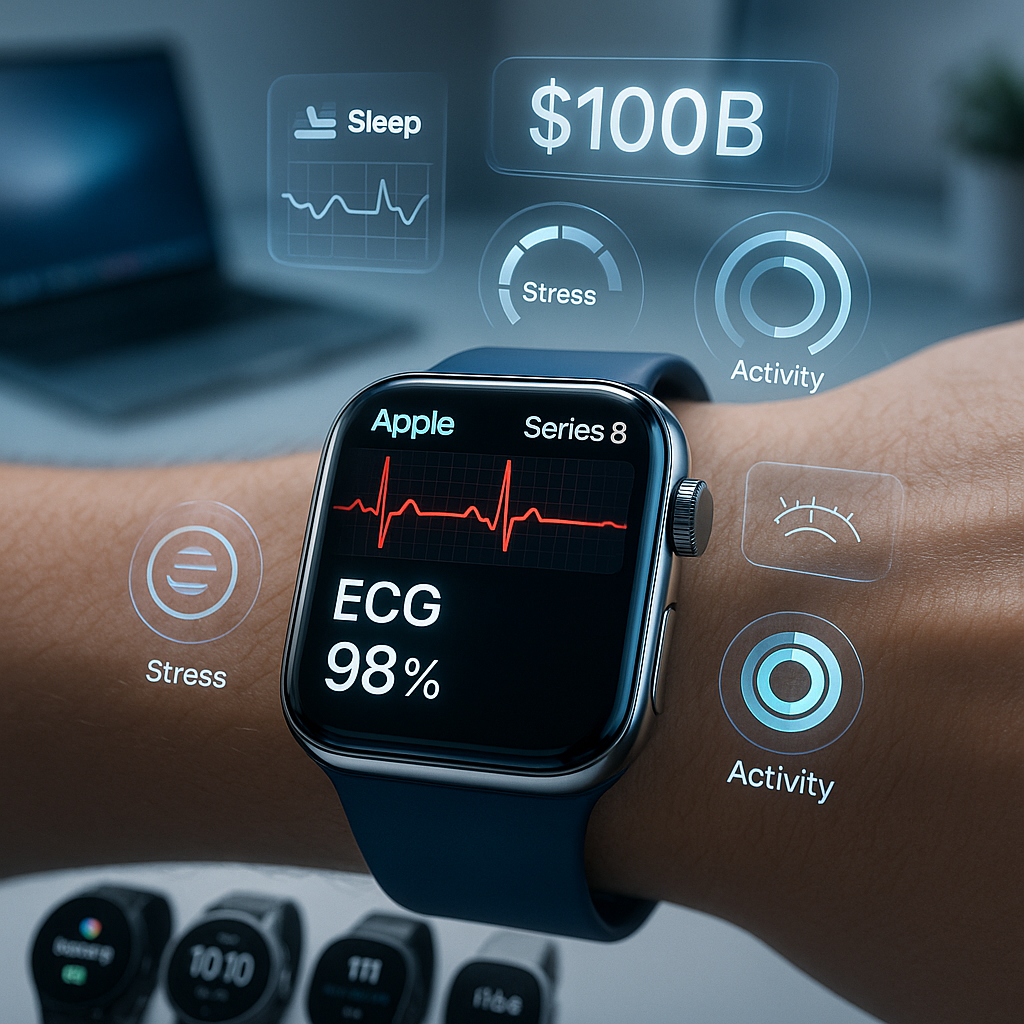
- Apple Watch revenue has surpassed $100 billion. This cements Apple’s leadership in the smartwatch market.
- Health-focused competitors such as Samsung, Garmin, and Fitbit are increasing investments in medical-grade sensors and features.
- Consumer demand for advanced health monitoring now outweighs style or basic functionality as a primary purchase driver.
- Regulatory clearances are becoming essential for the launch of new health-monitoring features.
- Industry analysts are closely watching Apple’s next steps, with expectations for advanced health sensors or new partnerships.
Introduction
Apple’s wearable division has reached a significant milestone, with Apple Watch revenue now exceeding $100 billion, according to company figures. This development solidifies Apple’s leading position in the global smartwatch market. As rival brands channel resources into advanced health features, future innovation and consumer choices are expected to focus heavily on health tracking and regulatory compliance.
Revenue Milestone Achievement
Apple Watch revenue has surpassed $100 billion since its launch in 2015, based on the company’s most recent financial report. This milestone reflects consistent growth for the product line over the past eight years.
In Q3 2023, the wearables division, led by Apple Watch, recorded a 14% year-over-year revenue increase, contributing about 11% to Apple’s total earnings. This represents a notable increase from the 7% share reported in 2019.
Erik Woodring, an analyst at Morgan Stanley, stated that the achievement “demonstrates Apple’s ability to create and dominate new product categories.” He also noted that Apple Watch now stands as the company’s third most successful product line after the iPhone and iPad.
Un passo avanti. Sempre.
Unisciti al nostro canale Telegram per ricevere
aggiornamenti mirati, notizie selezionate e contenuti che fanno davvero la differenza.
Zero distrazioni, solo ciò che conta.
 Entra nel Canale
Competitive Landscape Shifts
Competition in the smartwatch industry has intensified as major brands expand their health-monitoring capabilities. Samsung and Google have both launched new models with advanced health features, with Samsung’s Galaxy Watch series now capturing 18% of global market share according to Counterpoint Research.
Garmin remains strong in the specialized fitness segment, reporting a 22% increase in premium sports watch sales. Its emphasis on advanced athletic metrics and battery performance has helped preserve its niche.
Chinese manufacturers such as Xiaomi and Huawei have increased their presence in Asian and emerging markets by offering lower-cost alternatives with competitive features.
Health Monitoring Battleground
Health tracking has become the primary point of differentiation among smartwatch brands. Apple leads with several FDA-cleared features, including ECG monitoring and irregular rhythm notifications. Competitors are working to secure similar regulatory approvals.
Recent device innovations now enable continuous monitoring of:
- Sleep patterns and quality
- Blood oxygen levels
- Stress levels via heart rate variability
- Physical activity and recovery metrics
Medical professionals are increasingly recognizing the value of smartwatches for patient monitoring. Dr. Sarah Chen, cardiologist at Stanford Medical Center, noted that “wearable devices are becoming an integral part of preventive healthcare strategies.”
Regulatory Landscape
FDA clearance has emerged as a critical step for manufacturers introducing health-monitoring features. Industry experts note that the approval process can take between 6 and 18 months.
Across major brands, existing FDA-cleared features include ECG monitoring, irregular heart rhythm detection, and blood oxygen measurement. Samsung and Google are currently pursuing additional clearances for advanced capabilities.
Internationally, regulatory agencies such as the European Medicines Agency and Japan’s PMDA have adopted similar certification processes, creating a complex environment for global smartwatch manufacturers.
Market Outlook
Analysts project the global smartwatch market to reach $96.31 billion by 2027, largely driven by demand for health-monitoring features. IDC research director Ramon Llamas stated that “health features have become the primary purchase consideration for consumers.”
Ongoing supply chain challenges and regulatory requirements may affect product launches and availability through 2024. In response, major manufacturers are investing in alternative supply sources.
Competition around advanced health features is set to intensify, with leading brands investing heavily in research and development. JP Morgan analyst Mark Thomason commented that “the next battlefield will be in preventive health capabilities.”
Conclusion
The Apple Watch’s achievement of $100 billion in revenue highlights its growing influence in the wearables sector as health monitoring emerges as the primary area of competition. Regulatory requirements and supply challenges will continue to impact product development and release schedules. What to watch: forthcoming FDA approvals, supply chain developments, and continued innovation in health tracking through 2024.




Leave a Reply