
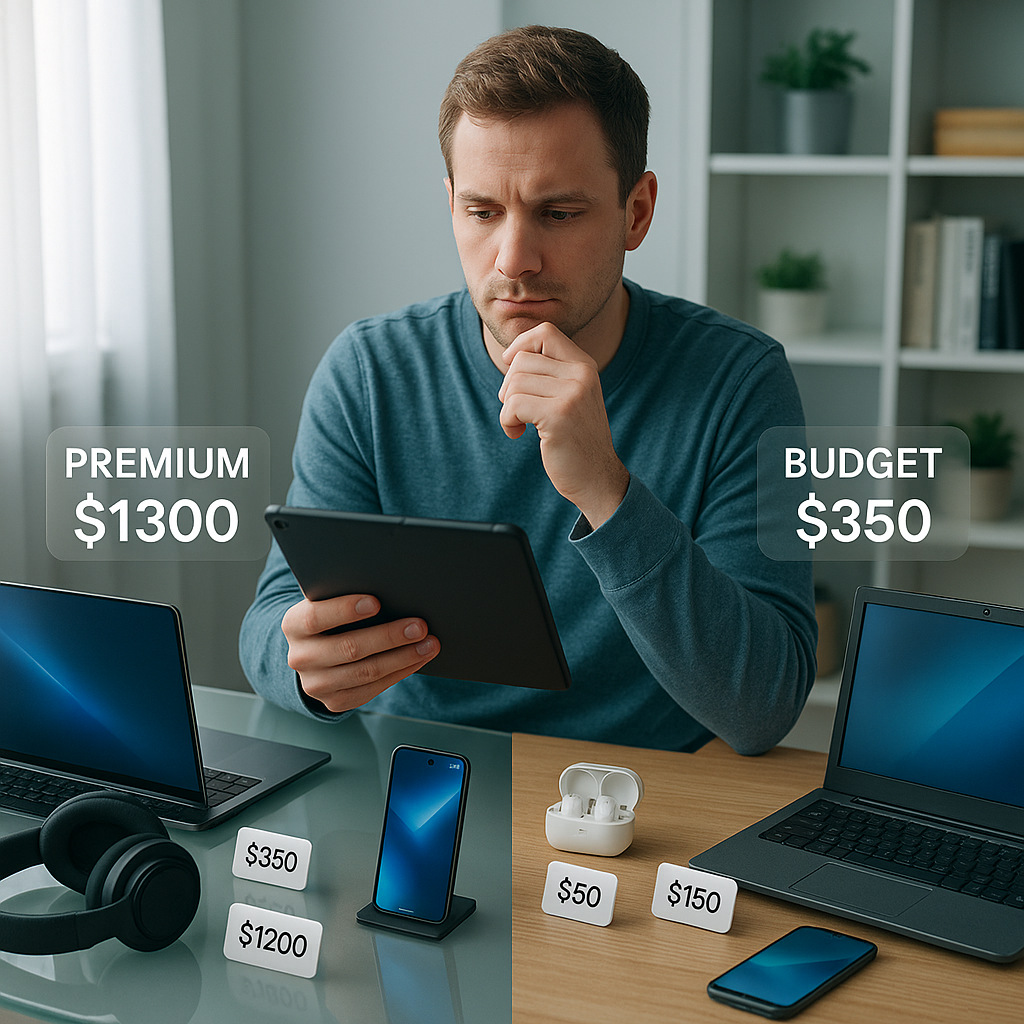

Key Takeaways
-
Prioritize what matters: Not all features are created equal. Clearly identify which features are truly essential for your daily routines versus those that are simply appealing extras. Premium gadgets often include an array of advanced functionalities, but many of these will have little practical impact for most users.
-
Budget alternatives can rival premium quality. Affordable technology has made significant strides in recent years. Today’s top budget gadgets frequently deliver excellent performance, durability, and design, successfully challenging many high-end models in real-world usage.
-
Think beyond the price tag: Assess long-term value. While premium gadgets may come with longer warranties, dedicated support, and superior craftsmanship, their higher price is not always justified. Sometimes, budget options make smarter investments due to their affordability and ease of replacement over time.
-
Spot genuine quality, not just clever branding. Confident marketing can dazzle, but the smartest buyers dig deeper by consulting trusted reviews, user testimonials, and expert comparisons. True quality emerges from real-world performance and durability, rather than just brand reputation.
-
Psychological traps: Buyer’s remorse is real on both sides. Regret stems from both ends of the spectrum. Some feel let down by cheap gadgets that don’t deliver, while others question investing in expensive models that underwhelm. Recognize your own motivations and manage expectations to avoid disappointment.
-
When premium is worth it: Specialized use cases or heavy daily reliance. For critical work, creative production, or devices that see heavy, daily use, premium options often pay off in reliability, advanced features, and long-term satisfaction.
-
Smart shopping means matching tech to your lifestyle. The ideal choice fits your habits, needs, and upgrade timing, not just your wallet. Align purchases with your true usage patterns for more enjoyment and less waste.
Making smart decisions in the budget versus premium debate goes much deeper than features and price. It’s about understanding needs, evaluating long-term value, and outsmarting psychological traps. Now, let’s explore how you can apply these principles to master your next tech purchase.
Introduction
Have you ever noticed a pricey $900 smartphone collecting dust, while a humble $200 device becomes your trusted companion? The debate over budget versus premium gadgets is about far more than hardware specifications or price tags. Ultimately, it’s about finding technology that harmonizes with your unique lifestyle, habits, and needs.
Decisions in the tech marketplace often involve navigating a maze of features, marketing hype, and continuous model upgrades. The true skill lies in assessing what will bring you the most value day-to-day and recognizing when a high price tag is justified, or when it merely signals status.
In this guide, we’ll break down how to identify authentic quality, weigh costs against actual benefits, and pick devices that truly enhance your life, minimizing regret and maximizing satisfaction.
Un passo avanti. Sempre.
Unisciti al nostro canale Telegram per ricevere
aggiornamenti mirati, notizie selezionate e contenuti che fanno davvero la differenza.
Zero distrazioni, solo ciò che conta.
 Entra nel Canale
Understanding the Real Value Proposition
Making informed tech choices starts by understanding where real value lies. The best gadget for you isn’t always the most expensive one. It’s the device that best matches your everyday demands without wasting money on unused potential.
Assessing Features Relative to Price
There’s often an assumption that higher prices guarantee better features, but the reality is less straightforward. As prices rise, the improvements tend to be incremental, leading many buyers to encounter diminishing returns.
- Diminishing returns: After hitting a certain price threshold, you pay significantly more for only modest gains in performance or features.
- Budget value sweet spot: Most affordable gadgets meet about 80–90% of common user requirements, from messaging and streaming to basic photography.
- Utilization reality: Studies show that the average user regularly taps into less than 40% of a premium device’s advanced capabilities.
Take, for example, the $399 Google Pixel 6a versus the $899 Pixel 7 Pro. The latter boasts superior zoom and faster processing, but these are only crucial for photography enthusiasts or power users. For most, daily tasks feel largely identical between the two models.
Quality Versus Quantity of Features
Premium gadgets often differentiate themselves through material quality, build, and the seamlessness of their user experience rather than an expanded feature set. Key differences include:
- Material excellence: Premium devices may utilize titanium frames, advanced glass, or reinforced designs.
- Performance optimization: Upgrades are most noticeable in demanding scenarios, not in day-to-day tasks.
- Ecosystem benefits: Integration with related products (such as smart home gear or wearables) can streamline usage and connectivity.
- Extended support: Longer software updates and better customer service are hallmarks of high-end brands.
For instance, the Samsung Galaxy A53 5G ($449) comes close to its sibling, the Galaxy S23 ($799), in terms of technical specs. Yet, premium models sport higher camera processing finesse, superior tactile feedback, and true-to-life displays. These are qualities the spec sheet alone can’t convey. Choosing what genuinely matters to your experience is essential for avoiding unnecessary spending.
Category-Specific Value Considerations
The optimal balance between price and performance differs across device types. By understanding specific considerations for each category, you can make smarter, tailored choices.
Smartphones: Everyday Essentials with a Premium Appeal
Since smartphones are our daily digital hub, premium features may be more valuable for some users:
- Camera innovation: High-end devices leverage computational photography to deliver dramatically better images, video stability, and night modes.
- Advanced display tech: Improvements such as higher refresh rates and enhanced brightness can be especially noticeable for outdoor use or gaming.
- Battery management: Premium phones often feature smarter optimization for longer real-world usage.
Case in point: The iPhone SE ($429) houses the same core processor as the iPhone 14 ($799) but forgoes advanced camera abilities and modern displays. For those who value portable photography or immersive screens, the higher investment is justified. Conversely, users seeking reliable communication and app performance may find the budget option perfectly adequate.
Laptops: Productivity Versus Portability
Laptop value is highly context-dependent:
- Professional tasks: Video editors, coders, and graphic artists benefit drastically from the premium segment’s raw power and superior screens.
- Academic and casual users: For web browsing, document editing, and streaming, mid-range models deliver similar experiences at a fraction of the cost.
- Durability & usability for on-the-go pros: Travelers and field workers often find that premium laptops pay for themselves through rugged construction and better customer support.
A student expecting light use may prefer the cost-effective Acer Swift 3 ($729), while a designer or executive could see strong returns investing in a Dell XPS 15 ($1,899) for performance and longevity.
Audio Equipment: Balancing Technology and Taste
Audio technology often reveals the most subjective preferences:
- Diminishing quality returns: Moving above the $300 mark, gains in sound quality become harder to discern for the average listener.
- Personal sound profiles: Much depends on whether you prefer crisp treble, deep bass, or a balanced signature. Sometimes this matters even more than objective fidelity ratings.
- Integrated features: Premium perks like active noise cancellation or auto-switching between devices can substantially improve user experience, especially in certain ecosystems.
For example, the $79 Anker Soundcore Liberty Air 2 Pro and $249 AirPods Pro may seem disparate, but many users can’t perceive a clear quality gap. However, Apple’s seamless connectivity and spatial audio features win over frequent travelers or multi-device users.
Expanding Across More Industries
Beyond personal tech, this budget versus premium decision model applies across many sectors:
- Healthcare: Premium diagnostic devices may offer higher accuracy and longer warranties, but many clinics successfully rely on affordable alternatives for routine screenings.
- Education: Schools often balance cost and function, sometimes opting for robust mid-range laptops or tablets that support digital learning without the price tag of professional-grade hardware.
- Finance: Budget-friendly tablets or computing devices support daily banking and retail operations, while investment bankers or algorithmic traders often justify premium tech for performance and reliability.
- Retail & E-commerce: Point-of-sale systems can be economical yet highly efficient, emphasizing the point that optimal tech doesn’t always mean the highest price.
By understanding these context-specific nuances, you can ensure your investments serve both your actual needs and budget.
Hidden Costs and Long-Term Economics
Total cost of ownership is about more than the price at checkout. Factoring in durability, ongoing maintenance, upgrade cycles, and ecosystem integration delivers a more accurate comparison between budget and premium gadgets.
Durability and Replacement Considerations
Upfront savings on a budget gadget can be quickly undone if frequent replacements are needed.
Un passo avanti. Sempre.
Unisciti al nostro canale Telegram per ricevere
aggiornamenti mirati, notizie selezionate e contenuti che fanno davvero la differenza.
Zero distrazioni, solo ciò che conta.
Entra nel Canale
- Premium devices generally receive software updates for five to seven years, while affordable models may drop support after two to three years.
- High-end hardware components show slower performance degradation.
- Better build quality means enhanced resilience to drops or daily wear.
For example, comparing a $1,200 MacBook Air (servicing users efficiently for over six years at about $200/year) against a $600 laptop (often replaced every three years, also $200/year, but with a drop in user satisfaction over time) shows how long-term value may favor the investment in premium devices. This is especially true when reliable performance matters.
Maintenance and Repair Economics
Another factor often overlooked is ease and cost of repairs:
- Premium brands support extended repair networks, offer authorized replacement parts, and return higher resale values.
- Budget models might offer fewer repair options, limited parts availability, and costlier repairs relative to initial purchase price.
For example, a display replacement in a budget phone can cost up to 60% of its original price, reducing the incentive to repair. Premium device repairs are proportionally less expensive, making it sensible to extend their lifespan.
Ecosystem Integration and Switching Costs
Choosing tech is rarely about a single purchase. Ecosystem effects play a critical role.
- Accessory savings: Premium devices sometimes share chargers or accessories across generations, which helps contain costs over multiple upgrade cycles.
- App investments: Subscriptions or purchased apps tied to a platform can make switching more costly.
- Workflow consistency: Learning a new interface or adjusting to different software slows productivity.
Apple’s ecosystem, for example, justifies some premium pricing by offering extraordinary interoperability. AirPods, for instance, travel effortlessly between a MacBook, iPad, and iPhone. This can potentially eliminate the need for multiple sets of headphones.
Understanding hidden costs and ecosystem effects empowers you to make more future-proof choices, avoiding the mistaken belief that initial savings always translate to lasting value.
Psychological Traps and Buyer’s Remorse
Buying gadgets is not only a rational process. Psychological and social forces heavily influence our perceptions, satisfaction, and, ultimately, our regrets.
The Allure of Branding and Social Status
Premium gadgets are often symbols as much as they are tools.
- Status signaling: Flashier designs and displays (like the illuminated MacBook logo or distinct camera arrays) are engineered to stand out.
- Community identity: Association with certain brands (e.g., Apple, Samsung) can foster a sense of belonging.
- Self-image: Upgrading to the latest device can feel like progress or personal reward.
Interestingly, studies indicate that about one-third of premium tech purchases are driven by these status and belonging needs, not strictly by intended functionality.
Managing Expectations to Reduce Regret
Common sources of buyer’s remorse are both psychological and practical.
- Gap between expectations and reality: Marketing raises hopes that even advanced products can struggle to meet.
- Post-purchase second-guessing: Continued browsing can reveal better deals or preferred alternatives.
- Visible opportunity costs: Recognizing how else the money might have been spent.
- Pressure to justify spending: Feeling compelled to use advanced features to rationalize the cost.
Consumer research shows users of mid-range products often report higher satisfaction than those who splurge or skimp. This “sweet spot” occurs when purchases exceed only what’s necessary, reducing both “what did I miss out on?” and “did I overspend?” regrets.
Strategies for Smarter, Satisfying Purchases
To ensure your tech investments deliver lasting satisfaction rather than second-guessing, consider these tactics:
- Impose a cooling-off period: Waiting at least 48 hours before making major purchases helps you distinguish impulse from necessity.
- Get specific with use cases: Avoid buying “just in case” by clearly outlining the situations you’ll need those extra features.
- Audit for feature usage: Make a checklist of which high-end features you’ll actually leverage, both immediately and over time.
- Calculate “joy per dollar”: Divide your anticipated genuine enjoyment and efficiency gains by the total cost to clarify true value.
Professional reviewers frequently report returning to simpler devices after lengthy hands-on trials with premium flagships; it’s a reminder that consistent, reliable satisfaction often trumps theoretical capability.
Conclusion
The ongoing debate between budget and premium technology is not settled by specs alone, but by the thoughtful alignment of device capabilities with your real-world needs. While top-tier gadgets deliver longer lifespans, elegant designs, and seamless operation—with undeniable value for heavy users and those deeply invested in specific ecosystems—budget-friendly options keep raising the bar, often delivering peak practicality at an unbeatable price.
Long-term satisfaction comes from self-awareness: honestly assessing your habits, understanding the total costs, and sidestepping psychological traps set by marketers and social pressures. By focusing on intentional, data-driven decisions instead of hype or fleeting trends, you empower yourself to optimize both spend and enjoyment. In a rapidly evolving digital world, the most powerful investment is not the flashiest upgrade, but the choice that best aligns with your needs. This helps you stay agile, confident, and ready for whatever comes next.
Looking forward, those who develop the ability to assess technology through the lens of personal value, long-term economics, and adaptability will set themselves apart in a crowded marketplace. Whether you are optimizing your home office, gearing up your small business, or equipping your classroom, your sensei-level tech savvy will ensure smart, sustainable, and satisfying investments—today and for the future.
eco gadgets
refurbished tech deals
digital routine
digital declutter




Leave a Reply