

Key Takeaways
- Model achieves state-of-the-art results: DeepSeek’s open-source AI matches or outperforms proprietary competitors on key natural language tasks.
- Designed for efficiency: The model is optimized to require significantly less computational power, lowering both costs and energy use.
- Accessible to all: Source code and pretrained weights are publicly available, supporting community research and real-world application.
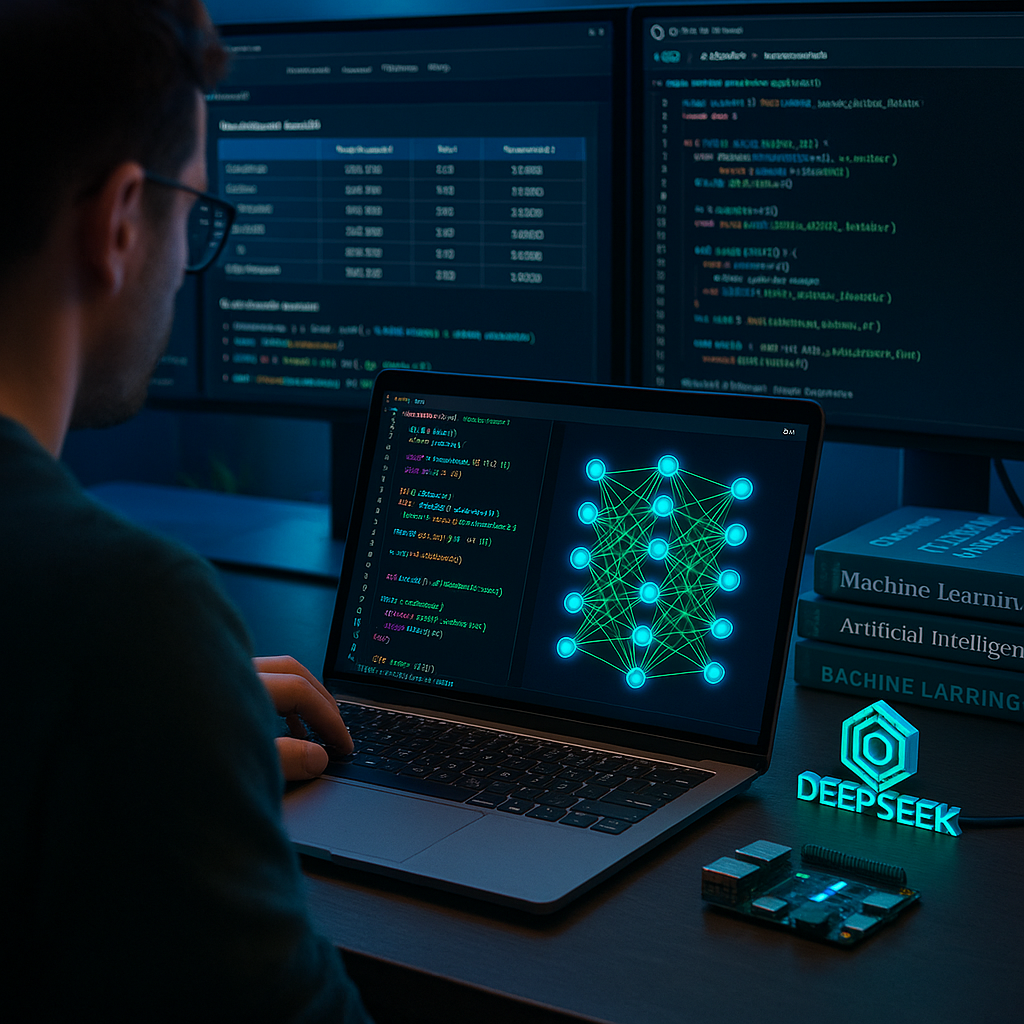
- Ideal for smaller devices: Streamlined architecture allows the AI model to run on edge hardware and consumer laptops, not just data centers.
- Business and developer focus: DeepSeek cites use cases across startups, research labs, and SMBs seeking affordable, robust AI.
- Community contributions encouraged: The company invites developers to participate in ongoing improvements via GitHub.
Introduction
DeepSeek has launched an open-source AI model designed to rival top proprietary systems on key language tasks. It uses significantly less power. This makes advanced artificial intelligence more accessible and energy-efficient for developers and businesses. By releasing source code and pretrained weights on its website and GitHub, DeepSeek aims to empower a wide range of users (from startups to hobbyists) seeking robust and affordable AI solutions.
The Technology Behind DeepSeek’s Open-Source Model
DeepSeek’s newly released open-source AI model features 7 billion parameters, positioning it competitively against similar-sized models from other AI labs. The model was trained on over 2 trillion tokens of data, including code, research papers, and general web text.
Built on a transformer architecture with several proprietary improvements, DeepSeek’s model incorporates a novel attention mechanism that the company claims enhances context handling. These technical enhancements allow the model to process longer sequences more efficiently than comparable open-source alternatives.
The model demonstrates particular strength in code generation and technical reasoning tasks. It outperforms similarly-sized competitors on standard benchmarks. DeepSeek researchers stated that their training methodology focused on reducing hallucinations while maintaining creative capabilities.
Un passo avanti. Sempre.
Unisciti al nostro canale Telegram per ricevere
aggiornamenti mirati, notizie selezionate e contenuti che fanno davvero la differenza.
Zero distrazioni, solo ciò che conta.
 Entra nel Canale
Performance Benchmarks and Capabilities
DeepSeek’s model achieved impressive results across standard AI benchmarks, scoring 78.2% on the MMLU (Massive Multitask Language Understanding) test. This outperformed several larger models. For coding-specific evaluations, the model solved 67% of problems on HumanEval and 65% on MBPP.
The model shows notable strength in mathematical reasoning and technical documentation generation, areas where smaller open-source models have traditionally struggled. Third-party testing confirmed the model maintains high accuracy when handling complex instructions.
DeepSeek stated that their model excels at maintaining context over longer conversations compared to others in its size class. Dr. Lin Wei, DeepSeek’s head of research, noted a specific focus on improving coherence in multi-turn interactions.
Open-Source Licensing and Accessibility
DeepSeek released its model under the Apache 2.0 license, allowing both commercial and research applications with minimal restrictions. This permissive licensing approach contrasts with some competitors who use more restrictive terms for commercial use.
The full model weights, training methodology documentation, and inference code are available on GitHub and Hugging Face. DeepSeek has also released smaller, more efficient variants optimized for deployment on consumer hardware.
To support a broader developer base, the company has provided comprehensive documentation to facilitate fine-tuning for specific applications. A dedicated community Discord server is available to address implementation questions.
Industry Implications and Expert Reactions
AI researchers have responded positively to DeepSeek’s release, highlighting the model’s performance-to-size ratio as particularly impressive. Dr. Sarah Chen, an AI researcher at UC Berkeley, stated that this raises the bar for models in the 7 billion parameter range.
Industry analysts suggest this release could accelerate the trend toward more capable open-source AI systems. It may potentially challenge the dominance of closed proprietary models. Several startups have already announced plans to build commercial applications on DeepSeek’s foundation model.
Some experts caution that although the model represents significant progress, it still exhibits limitations common to language models, such as potential factual errors and reasoning flaws. Rajiv Patel, an AI ethics researcher, explained that the openness of the model will help the community address these challenges collaboratively.
Company Background and Future Roadmap
DeepSeek, founded in 2021 by former researchers from leading AI labs, has grown to a team of over 120 AI specialists across offices in San Francisco and Beijing. The company has raised $150 million across two funding rounds, with investors including prominent technology venture capital firms.
This open-source release aligns with DeepSeek’s stated mission of democratizing access to advanced AI capabilities. The company has committed to quarterly updates for the model and plans to release larger parameter versions in early 2024.
Looking ahead, DeepSeek executives indicated that future development will focus on multimodal capabilities and enhanced reasoning. Mei Zhang, DeepSeek’s CEO, stated that work is underway to incorporate image understanding and more sophisticated planning abilities.
Conclusion
DeepSeek’s open-source AI model expands access to high-performing language tools, competing with larger systems while running efficiently on mainstream hardware. Its permissive licensing and strong benchmark results signal a significant shift toward more open, developer-friendly AI solutions. What to watch: DeepSeek’s upcoming quarterly updates and the release of larger model versions anticipated in early 2024.




Leave a Reply