

Key Takeaways
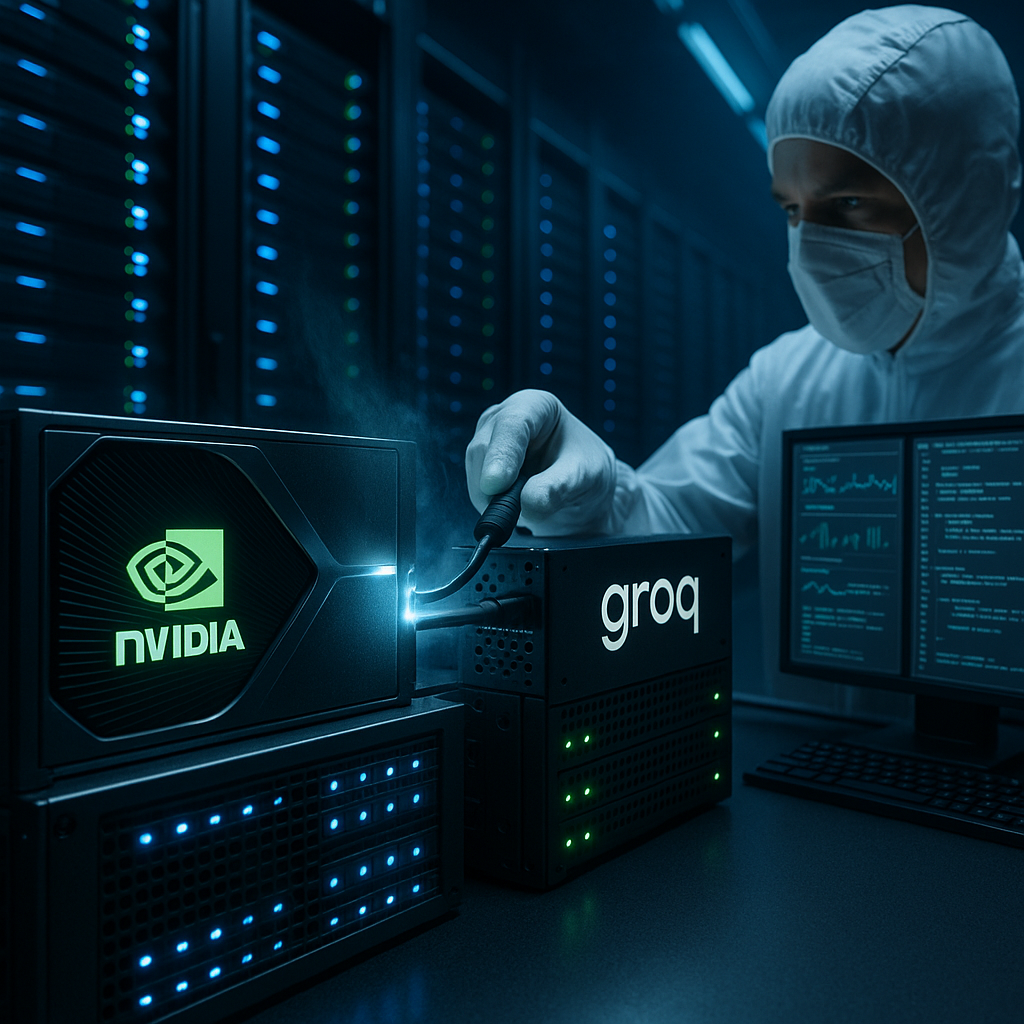
- On 27 December 2025, today’s tech news press review highlights Nvidia’s strategic partnership with AI startup Groq, marking a significant talent acquisition in artificial intelligence.
- Top story: Nvidia teams up with Groq, bringing on board its founder and top engineers to advance AI capabilities.
- Google launches Gemini 3 Flash, a real-time AI model aimed at faster, practical applications.
- OpenAI sees key researchers depart for Meta amid an escalating battle for AI talent in 2025.
- Detection-resistant deepfakes emerge, underscoring new concerns over digital security and authenticity.
- Tech giants’ strategies are increasingly shaping innovation and market competition.
Introduction
On 27 December 2025, the tech news press review spotlights Nvidia’s strategic partnership with AI startup Groq, as the company brings in key engineers and its founder to strengthen artificial intelligence efforts. At the same time, Google launches Gemini 3 Flash for real-time AI, illustrating a rapidly evolving landscape shaped by constant innovation and competition for talent.
Top Story
Nvidia Announces Strategic Partnership with Groq
Nvidia has formed a strategic partnership with AI hardware startup Groq to integrate Groq’s language processing unit (LPU) technology into Nvidia’s AI platforms. This collaboration seeks to address the rising demand for more efficient inference capabilities, while reinforcing Nvidia’s leadership in the AI training market.
The agreement involves Nvidia licensing Groq’s hardware architecture for specialized AI workloads, particularly those related to generative AI applications. Groq’s LPU chips have reportedly demonstrated performance up to 20 times faster than Nvidia’s GPUs for certain large language model applications, as shown in independent benchmarks released last month.
Nvidia CEO Jensen Huang stated that the partnership combines both companies’ strengths. He noted that while Nvidia’s GPUs remain unmatched for training, Groq’s approach to inference complements Nvidia’s ecosystem. The first integrated products are scheduled for release in the second quarter of 2026, with both companies collaborating on software integration through Nvidia’s CUDA platform.
Un passo avanti. Sempre.
Unisciti al nostro canale Telegram per ricevere
aggiornamenti mirati, notizie selezionate e contenuti che fanno davvero la differenza.
Zero distrazioni, solo ciò che conta.
 Entra nel Canale
Also Today
AI Competition Intensifies
Google’s TPU v5 Unveiling
Google Cloud has unveiled its TPU v5 accelerator chips, claiming performance that doubles previous generations for AI workloads. These custom-designed accelerators are now available to enterprise customers through Google Cloud’s AI platform.
The TPU v5 architecture features a redesigned matrix multiplication unit and upgraded memory bandwidth, optimized for transformer model architectures. Google Cloud CEO Thomas Kurian emphasized that these TPUs focus on generative AI, allowing customers to run models like PaLM 2 and Gemini at lower costs and higher throughput.
According to internal tests, TPU v5 outperformed comparable chips on large language model inference by up to 40% on a performance-per-watt basis. Google has already deployed the chips to power products such as Bard and Search Generative Experience, demonstrating its integrated approach.
Microsoft’s Azure AI Supercomputer
Microsoft has completed construction of its largest AI-specific supercomputer, featuring over 10,000 Nvidia H100 GPUs connected by InfiniBand networking. Located in Virginia, this system significantly expands Microsoft’s AI infrastructure amid increased demand from both proprietary products and cloud customers.
The supercomputer primarily supports OpenAI’s training needs for future GPT models. Microsoft Chief Technology Officer Kevin Scott reported that the system is running at near-full capacity, dedicating 80% of resources to model training and the remainder to inference for Azure OpenAI Service customers.
Analysts estimate that Microsoft’s investment in AI computing infrastructure has surpassed \$5 billion this year. The company plans to build three more AI supercomputing clusters in 2026, as noted in local planning documents.
Hardware Innovation
Apple’s M4 Ultra Chip Plans
Apple is preparing to release its most powerful chip yet, the M4 Ultra, expected to debut in Mac Pro and high-end Mac Studio models in early 2026. Supply chain sources indicate the chip will feature up to 32 CPU cores and 80 GPU cores, built using TSMC’s advanced 3nm process.
The M4 Ultra marks Apple’s continued entry into professional computing markets traditionally dominated by Intel and AMD. Early benchmark tests from development units show gains of 30 to 40% over the M3 Ultra in multi-threaded workloads, with notable improvements in AI tasks due to an expanded Neural Engine.
Insiders report that Apple has substantially increased its orders of high-bandwidth memory from Samsung and SK Hynix to support the new chip’s needs. This move signals Apple’s intent to compete more aggressively in AI computing as it introduces Apple Intelligence features across its product range.
Samsung’s Advanced Memory Solutions
Samsung Electronics has announced mass production of its HBM3E (High Bandwidth Memory) modules, which offer 36GB capacity and transfer rates exceeding 9 gigabits per second. These modules are a critical component for AI accelerator chips used by Nvidia, AMD, and Google.
The company stated that the improved memory bandwidth addresses key bottlenecks in current AI systems, especially for large language model training. Samsung Display President Jun Young-hyun said the company has secured sufficient capacity to meet rising demand, even amid industry-wide supply constraints.
Initial shipments have already reached major AI chip manufacturers. Samsung expects HBM modules to contribute significantly to semiconductor division profits in 2026. Industry analysts project the global HBM market will grow at 116% annually through 2027, driven mainly by the expansion of AI data centers.
Security Threats
Zero-Day Exploits Target Cloud Platforms
Security researchers at Google’s Project Zero team have identified multiple zero-day vulnerabilities affecting major cloud providers. These flaws, found in widely used virtualization software, could allow attackers to escape VM instances and access other customers’ data on shared infrastructure.
Cloud service providers such as AWS, Microsoft Azure, and Google Cloud have issued emergency patches to address these vulnerabilities. Security experts caution that full remediation depends on customers updating their guest operating systems and applications. AWS Chief Security Officer Stephen Schmidt emphasized that a complete security posture requires coordination between service provider and customer.
At least three confirmed attacks on financial services organizations occurred before the release of patches. The Cybersecurity and Infrastructure Security Agency has issued an emergency directive requiring U.S. federal agencies to apply all recommended mitigations by 30 December 2025.
Ransomware Groups Target Healthcare Systems
A coordinated ransomware campaign has impacted multiple U.S. healthcare providers, affecting operations at 17 hospitals across three states. According to authorities, the attacks, attributed to the BlackCat ransomware group, disrupted electronic health record systems and forced some facilities to use paper processes.
Un passo avanti. Sempre.
Unisciti al nostro canale Telegram per ricevere
aggiornamenti mirati, notizie selezionate e contenuti che fanno davvero la differenza.
Zero distrazioni, solo ciò che conta.
Entra nel Canale
Hospital administrators indicated that while patient care was not compromised, scheduling systems and diagnostic platforms experienced significant disruption. The FBI confirmed it is investigating and is working with affected organizations to restore systems and trace attack vectors.
Cybersecurity firm Mandiant stated that the attackers exploited recently patched vulnerabilities in healthcare-specific software, highlighting persistent security challenges in the sector. Healthcare remains a prime ransomware target, with attacks up 35% year-over-year due to the sector’s critical services and sensitive data.
What to Watch
Key Dates and Events
- 30 December 2025: Nvidia and Groq will host a joint developer conference to showcase their integrated hardware and software solutions.
- 8 to 12 January 2026: CES 2026 in Las Vegas will feature major AI hardware announcements, including keynotes from Nvidia, Intel, and AMD executives.
- 15 January 2026: Apple’s special event is expected to introduce new Mac models featuring the M4 chip family.
- 23 January 2026: Google Cloud Next conference, with anticipated updates on TPU availability and enterprise pricing.
- 5 February 2026: Microsoft’s annual AI research summit, where the company typically shares details about its AI infrastructure and development plans.
Conclusion
Nvidia’s partnership with Groq emerges as a pivotal moment in this tech news press review, illustrating the industry-wide race to improve AI performance and efficiency. Continuing hardware innovation and growing cybersecurity threats highlight the need for both progress and vigilance.
For more on digital risks and practical defense, read our guide to cyber hygiene.
What to watch: Upcoming product launches and events from Nvidia, Apple, Google, and Microsoft will help define the AI landscape in early 2026.


Leave a Reply