

Key Takeaways
- VPNs deliver end-to-end encryption for complete privacy: VPNs encrypt all of your internet traffic, masking both your identity (IP address) and your data from hackers, ISPs, and even public Wi-Fi eavesdroppers. This comprehensive approach makes VPNs the gold standard for secure browsing and data protection.
- Proxies offer speedy, lightweight IP masking for low-risk tasks: While proxies do not encrypt your data, they excel at fast connections and simple IP obfuscation. They are ideal for activities such as bypassing content restrictions at work or conducting non-sensitive web scraping.
- Match your tool to your threat level and task: For accessing public Wi-Fi, sharing sensitive information, or working remotely from abroad, a VPN provides robust security. If your goal is just to bypass basic geo-blocks or handle non-confidential data, a proxy’s speed and simplicity could be sufficient.
- Encryption is essential for genuine online anonymity: VPNs encrypt your entire data stream in addition to your IP address. This offers a more substantial safeguard against privacy leaks and makes your digital footprint far more difficult for others to monitor or exploit, compared to proxies.
- Be cautious with “free” VPNs and proxies: Many free services compromise your safety by selling your data, injecting intrusive ads, or offering weak protection. It’s vital to research your provider’s reputation to ensure you are not sacrificing your privacy for convenience.
- Recognize the trade-off: security versus speed: Because VPNs encrypt your traffic, they may cause a modest decrease in connection speed. Proxies, while typically faster, provide significantly less protection. Choose according to whether privacy or performance aligns better with your current priorities.
- Situational advantage: proxies thrive in speed-critical, low-security cases: When speed is more important than bulletproof security, such as for streaming or processing large volumes of non-sensitive data, proxies often outperform VPNs without introducing the delays associated with encryption.
By understanding these nuanced differences between VPNs and proxies, you can better select the privacy tool that delivers not just greater safety but smarter protection tailored to your specific needs. Read on to explore exactly how each technology operates, their strengths and weaknesses in real-world scenarios across various industries, and a guide to making the best choice for your unique internet habits.
Introduction
Online privacy is not only threatened by hackers. It’s also at risk from internet service providers, public Wi-Fi networks, and websites you visit every day. Deciding between a VPN and a proxy might seem straightforward, but the real distinction between their security capabilities can determine whether you achieve actual online anonymity or are lulled into a false sense of safety.
VPNs provide powerful data encryption and broad cybersecurity benefits, covering everything from browsing to data transmission. Proxies, on the other hand, are focused on speed and offer lightweight IP masking, suitable for less sensitive online tasks. Gaining a clear understanding of how each solution works (and when to use it) can be the deciding factor between secure browsing and exposing your critical information. Let’s unravel the core contrasts of VPNs versus proxies, empowering you to make informed decisions for your online routine.
Understanding VPNs and Proxies
After highlighting their importance, it’s crucial to understand the technologies at play so you can fully appreciate the level of protection you can expect from each.
Un passo avanti. Sempre.
Unisciti al nostro canale Telegram per ricevere
aggiornamenti mirati, notizie selezionate e contenuti che fanno davvero la differenza.
Zero distrazioni, solo ciò che conta.
 Entra nel Canale
How VPNs Work
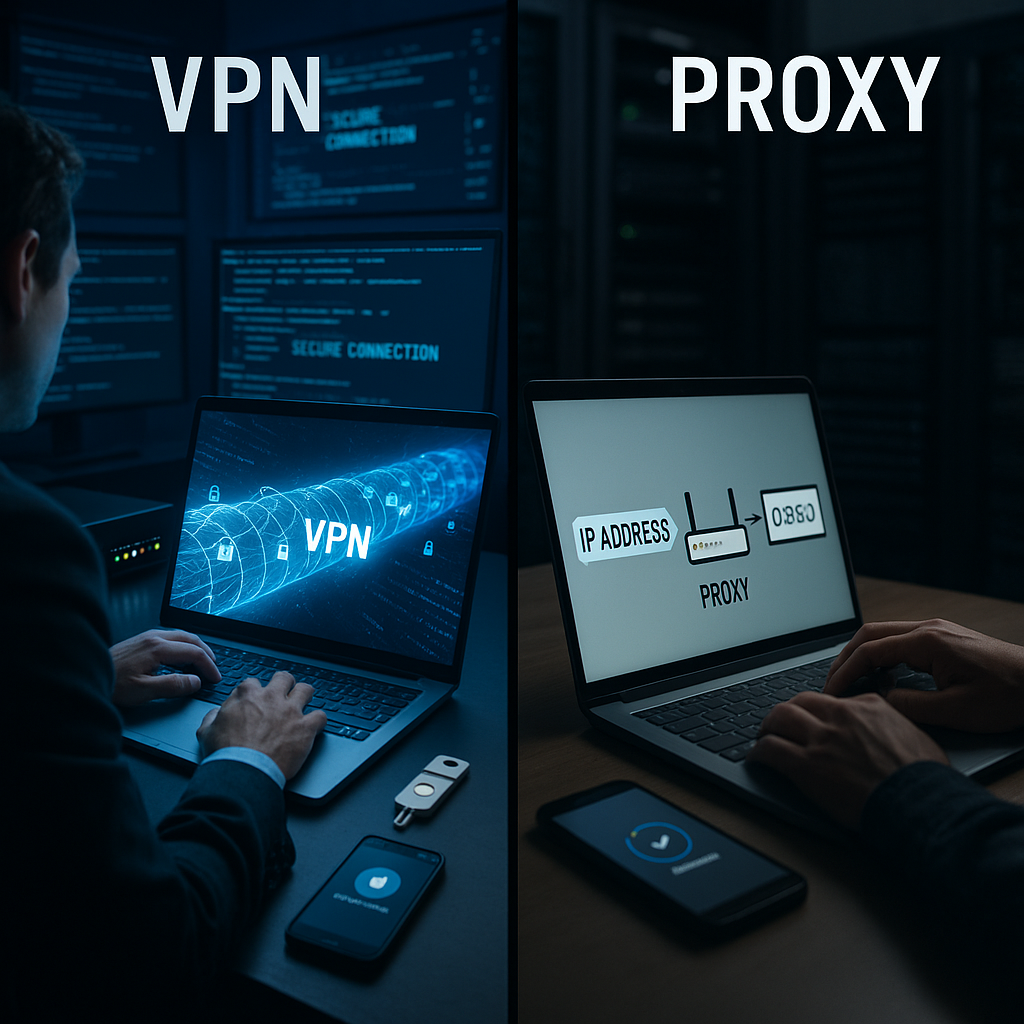
A Virtual Private Network (VPN) establishes an encrypted tunnel between your device and the broader internet. This tunnel ensures that every piece of data you send or receive travels safely. Shielded from prying eyes every step of the way.
Key VPN Components:
- Advanced encryption protocols to scramble your data
- Network of secure servers located globally to reroute your connections
- Masking of your real IP address, disguising your true location
- Protection that spans your entire device, impacting all applications and browsers
Think of a VPN as a secure courier service. It picks up your data from your digital doorstep, locks it in a fortified van, and navigates unpredictable routes to deliver it safely to its destination. The entire journey is invisible to onlookers.
How Proxies Work
A proxy server acts as a relay between your device and the website or service you wish to access. By fetching information on your behalf, it hides your IP address from the outside world. However, this system usually applies only to the specific app or browser you’ve configured to use the proxy.
Proxy Characteristics:
- Focus on individual applications or browsers, not your whole device
- Conceals your IP address from accessed websites and services
- Typically lacks encryption, leaving transmitted data exposed
- Speedier performance due to streamlined, minimal security features
Picture a proxy as a mail-forwarding service. It masks your return address by rerouting your messages, but it doesn’t secure or lock the envelope’s contents. A trade-off between convenience and safety.
Comparing Encryption and Security
With the basics established, evaluating the specific security protections offered by each tool will help you identify which aligns with your needs across different use cases.
VPN Security Features
VPNs employ robust encryption protocols such as AES-256, which ensure that all your digital activities (from web browsing to banking) are wrapped in multiple layers of protection.
What VPNs Protect:
- Complete web activity and browsing history
- Downloads and uploads, including sensitive documents
- Private communication like messages and emails
- Financial details within banking and online payment portals
Real-world Impact: A properly configured VPN guards against ISP spying, data interception on public Wi-Fi, and even government surveillance. According to recent cybersecurity research, VPNs have a 99.9% success rate at stopping man-in-the-middle attacks, making them indispensable for industries dealing with confidential information. For example, financial organizations and healthcare providers rely on VPNs to protect client data, while legal professionals use them to ensure confidentiality in case management and client communication.
For more in-depth guidance, see our VPN setup guide for beginners.
Proxy Security Features
Proxies provide a foundational level of privacy by masking your IP address, but their lack of encryption introduces clear vulnerabilities.
What Proxies Offer:
- Basic concealment of your IP address
- Limited privacy for individual applications
- Optional support for HTTPS, which somewhat protects web traffic if implemented
- The ability to circumvent geographic restrictions or filters
Security Gap: Without encryption, proxies leave your data susceptible to interception, especially on unsecured public networks. Notably, 71% of cyberattacks on consumer and business data occur on unencrypted Wi-Fi, underlining the limited role proxies should play in safeguarding privacy. In retail environments, for instance, proxies might assist with monitoring pricing information from competitors, but without encryption, sensitive business plans could be at risk.
Use Cases and Practical Applications
The best results come from matching the right tool to each situation. Let’s look at various real-world applications across major industries.
When to Use a VPN
High-Security Scenarios:
Un passo avanti. Sempre.
Unisciti al nostro canale Telegram per ricevere
aggiornamenti mirati, notizie selezionate e contenuti che fanno davvero la differenza.
Zero distrazioni, solo ciò che conta.
Entra nel Canale
- Remote work that involves access to proprietary business data in sectors like finance, healthcare, or law
- Secure online banking and personal financial management
- Connecting to public Wi-Fi at cafes, airports, libraries, or hotels. These are popular targets for cybercriminals
- Legally accessing region-restricted streaming content while traveling abroad
- Guarding against surveillance and data collection by ISPs, government agencies, or unauthorized third parties
- Healthcare professionals managing patient records and telemedicine appointments
- Educators and students handling confidential learning data during distance education
To understand the broader importance of end-to-end encryption in safeguarding such activities, check out our comprehensive overview.
When to Use a Proxy
Speed-Priority Scenarios:
- General browsing or reading online content where no sensitive data is involved
- Instantly switching your apparent location to test websites or compare regional content and pricing
- Large-scale data extraction or web scraping for market research or trend analysis
- Running automated scripts that require fast, repeated web requests, like SEO monitoring tools or e-commerce price tracking
- Circumventing basic geo-restrictions for non-sensitive content, such as viewing sports results or accessing regional product listings
- Marketing professionals conducting ad verification from different geographic locations
Pros and Cons Analysis
A closer look at the strengths and trade-offs of VPNs and proxies ensures you select what serves your goals best.
VPN Advantages and Limitations
Pros:
- End-to-end encryption of all data traffic for comprehensive privacy
- Broad protection that covers all device applications and services
- Adherence to stringent no-log policies (with trustworthy providers)
- Defense against complex tracking, such as deep packet inspection
- Frequent security updates and dedicated technical support
Cons:
- Potential reduction in connection speed of 10-15% because of encryption processing
- Higher subscription cost, typically $3-12 per month for reliable services
- Slightly more involved setup process compared to proxies
- May require technical assistance, especially for integration with business networks
Proxy Advantages and Limitations
Pros:
- Low impact on connection speed, with an average decrease of only 2-5%
- Generally lower cost, around $1-5 per month, making them highly affordable for casual needs
- Simple and quick setup, often within minutes
- Flexibility to apply settings only to certain applications (ideal for specific workflows)
Cons:
- No built-in encryption, so transmitted data is not protected
- Narrow protection scope. Only secures traffic from the chosen application or browser
- Less reliable connections, leading to more frequent drops or disruptions
- Minimal or nonexistent customer support, increasing risk when issues arise
Risks of Free Services
Many users are tempted by no-cost privacy tools, but free VPNs and proxies can put your privacy in greater jeopardy.
Free VPN Dangers
Current research indicates:
- 38% of free VPNs contain some form of malware
- 84% leak user data to third parties
Additional common threats include:
- Unauthorized collection and sale of your browsing data
- Risk of malware infection that can compromise your device
- Possibility of bandwidth theft, affecting your own connections
- Unstable and slow connections, which can disrupt work
- Limited access to server locations, reducing effectiveness
Explore the pros and cons of free antivirus apps for additional context on security trade-offs associated with no-cost online protection.
Free Proxy Risks
Problems with free proxy services can be even more severe:
- 79% do not support secure HTTPS connections, increasing vulnerability
- 67% have been shown to alter and manipulate user traffic
- 25% redirect users to dangerous or fraudulent websites
- High rate of data theft incidents, affecting both consumers and businesses
- Frequent connection failures, impacting workflow and productivity
Across sectors such as education or small business operations, relying on free privacy solutions can open doors to cybercrime, data loss, or identity theft.
Expert Tips for Choosing Between VPN and Proxy
Evaluating your decision against clear and practical criteria makes it easier to choose the right tool for your situation.
Decision Framework
- Security Priority Level
- If you are handling financial or personal data, opt for a VPN.
- For casual, non-sensitive browsing, a proxy could be sufficient.
- Performance Requirements
- If speed is critical (such as for bulk data collection or media streaming), a proxy may be optimal.
- If safeguarding confidential data is a priority, use a VPN.
- Budget Considerations
- Consider the long-term costs and benefits of enhanced security.
- Explore bundled privacy packages for economies of scale, particularly for businesses or remote teams.
- Technical Expertise
- For users seeking simplicity, user-friendly VPNs offer easy setup and all-round protection.
- Tech-savvy users may benefit from customizing proxies for specialized, non-sensitive workflows.
Remember to always factor in your industry’s compliance requirements. For healthcare, finance, and legal sectors, regulatory frameworks may mandate the use of end-to-end encryption, making VPNs a non-negotiable baseline.
Conclusion
Recognizing the nuanced differences between VPNs and proxies is the foundation for robust digital privacy and security. VPNs deliver comprehensive encryption and powerful protection against a spectrum of threats, from ISP monitoring to cyberattacks on public networks. Proxies, with their speed and application-specific utility, suit workflows centered on access and convenience where minimal security is acceptable.
Importantly, the allure of free services should be met with caution. Across all fields, whether you’re working in finance, healthcare, education, marketing, or simply browsing at home, selecting reputable, paid providers is crucial for meaningful protection. Aligning your choice with your own privacy requirements, workflow needs, and budget ensures you stay one step ahead in the ever-evolving digital landscape.
Looking ahead, the most secure, tech-empowered users will be those who balance security, usability, and trust. Making proactive, informed decisions for every online interaction. With cyber threats growing more sophisticated each day, the question is not whether you will use these protective tools, but how adeptly you will leverage them to stay safe, productive, and confidently connected. Adopt a sensei mindset: keep learning, stay vigilant, and let clarity guide your every digital move.




Leave a Reply