

Key Takeaways
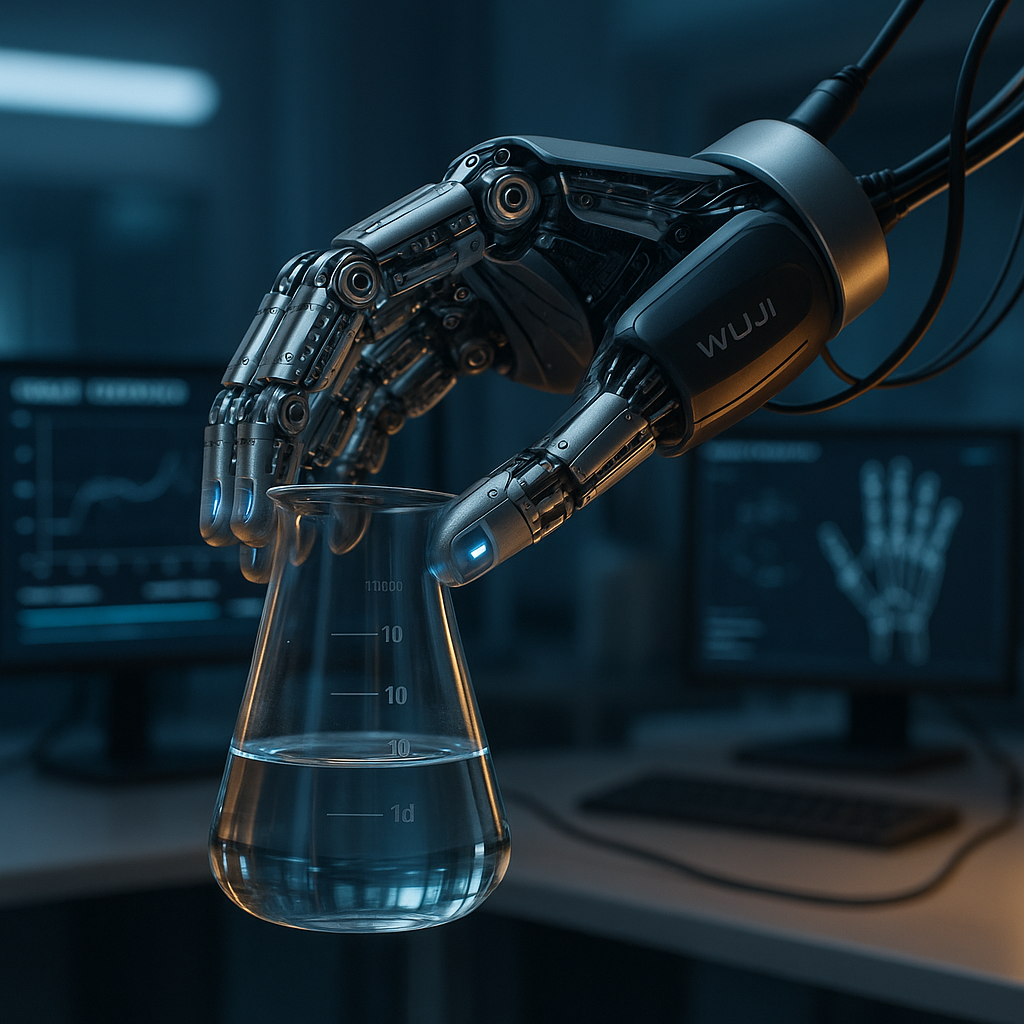
- Precision reimagined with 20 degrees of freedom: The Wuji Hand establishes a new benchmark in high-dexterity manipulation, featuring 20 independently actuated joints that faithfully replicate the intricate motion and articulation of the human hand.
- Human-like agility through advanced engineering: Wuji’s precisely crafted skeleton, lightweight structure, and robust tendon drives allow the hand to grasp, pinch, and manipulate with nearly human fluidity. This makes it particularly suitable for complex tasks across scientific research, healthcare, manufacturing, and service industries.
- API and SDK unlock seamless integration: In addition to advanced hardware, Wuji offers a comprehensive API and versatile SDK, empowering developers to integrate easily with ROS (Robot Operating System), implement customized control logic, and enable rapid deployment across diverse robotic platforms including those in education, logistics, and healthcare simulation.
- Smart sensing powers real-time feedback: Embedded force and tactile sensors deliver adaptive grip strength and on-the-fly self-correction. This minimizes object slippage and enhances safety in both autonomous and teleoperated workflows, supporting delicate lab instrumentation, patient assistance technologies, and more.
- Humanoid applications drive real-world value: Wuji Hand is the preferred manipulator in advanced humanoid robots. It excels in applications such as industrial sorting, medical and surgical simulation, prosthetic development for rehabilitation, and interactive service robotics in hospitality and retail.
- Cost-performance leadership in its class: The Wuji Hand combines accessible pricing with exceptional durability, rapid actuation, and robust fingertip strength. Its value proposition appeals to research labs, educational institutions, startups, and established businesses seeking advanced performance without excessive cost barriers.
- Designed to evolve with your robotics stack: Ongoing firmware updates, modular expandability, and a thriving developer community ensure the Wuji Hand stays at the cutting edge. This future-proofs investments for those seeking to maintain competitive advantage in fast-moving sectors.
Wuji robotic hands are not merely mechanical marvels. They represent complete, software-integrated platforms purpose-built for the emerging era of humanoid and collaborative robotics. In the sections below, we will explore the technical specifications, showcase real-world case studies, and dig into the software tools that make Wuji a catalyst for breakthrough innovation across multiple industries.
Introduction
Imagine a robotic hand that not only mimics, but equals the dexterity and precision of a human. Wuji robotic hands set the gold standard in humanoid engineering, fusing 20 degrees of freedom with advanced sensing and real-time adaptability in a design rivaling biological precision.
For researchers, developers, and roboticists at the forefront of innovation, the Wuji Hand is more than a mechanical milestone. It is a holistic platform engineered for effortless integration across a wide spectrum of applications, from next-generation prosthetics and surgical trainers to intelligent service robots and sophisticated assembly lines. The technical breakthroughs and developer-centric approach of the Wuji Tech robotic hand make it an essential solution for anyone seeking to elevate the possibilities of dexterous robotic manipulation.
In the following sections, we will examine how the Wuji Hand’s carefully designed architecture, unique engineering solutions, and vibrant developer network are changing the landscape for high-dexterity robotic hands.
Un passo avanti. Sempre.
Unisciti al nostro canale Telegram per ricevere
aggiornamenti mirati, notizie selezionate e contenuti che fanno davvero la differenza.
Zero distrazioni, solo ciò che conta.
 Entra nel Canale
Technical Architecture of Wuji Robotic Hands
The Wuji robotic hand sets a new standard in anthropomorphic manipulator design by integrating innovative mechanical engineering with advanced sensing and control. Its architecture is developed around three core priorities: replicating human-like dexterity, delivering strong force performance, and enabling high-precision manipulation.
Mechanical Design Principles
The foundation of the Wuji Hand consists of:
- Anthropomorphic Skeletal Frame: A titanium-aluminum alloy skeleton guarantees structural strength while keeping the device lightweight (3:1 strength-to-weight ratio compared to many traditional industrial manipulators). This ensures reliability in both research and real-world deployment.
- 20 Degrees of Freedom (DoF): Each finger features multiple joints (3 DoF per finger and 3 for the thumb), totaling 20 independently actuated axes. This configuration supports a wide range of grasp and manipulation patterns, capable of handling complex biomedical tools, surgical instruments, or even delicate pharmaceutical samples.
- Tendon-Driven Actuation: The hybrid cable-driven approach, powered by highly efficient micro-motors, minimizes distal weight while providing strong, consistent torque (up to 87% transmission efficiency). Such agility is essential for roles in consumer electronics assembly or operating delicate medical simulators.
- Modular Joint Assemblies: Each joint can be individually serviced or upgraded, reducing maintenance downtime by 60% compared to monolithic designs. This modularity is highly beneficial for rapid prototyping in academic settings and scalable industrial installations.
The palm’s structure acts as both the hand’s foundation and its systems hub. It holds critical components such as main circuit boards, processors, and power management units within a compact chassis. This integrated approach enables straightforward upgrades and efficient troubleshooting.
Actuation Systems and Power Distribution
Wuji Tech’s strategy for actuation maximizes both raw power and nuanced control:
- Distributed Motor Architecture: Instead of grouping all motors in the forearm, Wuji strategically distributes eight primary motors within the palm and twelve secondary actuators along proximal finger joints. This improves balance, enhances motion clarity, and supports more natural interaction.
- Proprietary Harmonic Drive Implementation: Custom, miniaturized harmonic drives in the finger joints deliver impressive peak torque (2.8 Nm) with virtually zero backlash, supporting demanding tasks in both research and industrial environments.
- Brushless DC Microdrives: These efficient drives work at 24V and are equipped with high-resolution encoders. They deliver accurate, real-time motion feedback. This is vital for steady operations in laboratory automation, clean-room assembly, or teleoperated surgery.
- Power Efficiency Optimization: The hand’s design keeps standard power usage at 45W, peaking at 120W during maximum load. The distributed architecture also allows emergency fail-safe operation (fingers maintain their last position even during partial power loss). This meets safety standards essential for healthcare and collaborative industrial settings.
Sensing Technologies and Feedback Systems
A standout feature of the Wuji Hand is its advanced sensor array, which enables closed-loop, real-time adaptive control.
- High-Resolution Tactile Sensing: With 248 pressure sensors distributed across the fingertips and palm, the Wuji Hand perceives both delicate and robust forces (from 0.01N to 10N) at 12-bit resolution. This capability is crucial for sensitive applications like biomedical research, surgery simulation, and precise machine assembly.
- Proprietary FingerTip™ Sensors: Each fingertip includes a three-dimensional force-sensing array, providing critical feedback for controlled grasping, slip detection, and adaptive force adjustment. These features are particularly useful in prosthetics, rehabilitation robotics, and consumer electronics handling.
- Joint Position Sensing: Magnetic encoders at each joint provide precise readings at 1kHz, allowing accurate repetition and safe, reliable operation in dynamic or unpredictable environments.
- Thermal and Vibration Feedback: Integrated temperature sensors adapt to changes in object material, while fingertip accelerometers detect micro-vibrations to recognize textures. This capability is valuable for quality inspection in manufacturing, educational robotics labs, and consumer product testing.
Sensor data is processed through a multi-tiered architecture, where low-level controllers provide rapid reactions (as quick as a 1ms response) and high-level systems manage complex task planning. Protective intermediate layers shield electronics while preserving tactile acuity, ensuring operation in varied climates and workspaces.
Specifications and Performance Metrics
The Wuji robotic hand excels across metrics critical to dexterous manipulation, positioning it as a leader in modern humanoid robotics.
Physical Dimensions and Weight
Balancing form and function, the Wuji Hand is engineered for seamless integration.
- Dimensions: 210mm (length) × 180mm (width) × 70mm (depth), closely matching the proportions of a typical human hand (95% scale).
- Weight: At just 1.2kg (including controllers), it is lightweight enough for mobile platforms, exoskeletal systems, and prosthetics.
- Finger and Palm Measurements: The index finger measures 88mm, while the palm reaches 35mm at its thickest point. These specifications deliver compatibility with a variety of accessories and wrist interface standards, notably the 6-bolt 50mm mounting commonly used in robotics research and prosthetic development.
Force Application and Load Capacity
Built to handle a wide range of objects and tasks.
- Maximum Grip Force: 120N supports power grips necessary for heavy objects in manufacturing and clinical devices.
- Fingertip Force: Each digit can exert up to 15N, adjustable to a minimum increment of 0.1N.
- Pinch Force: 40N achievable with thumb and index, enabling fine manipulation for laboratory research, component placement, and even surgical tool handling.
- Payload Capacity: Capable of lifting 2.5kg with a power grip and managing delicate tasks (up to 0.8kg) in precision scenarios, Wuji can adapt from warehouse sorting to pharmacy automation.
- Force Control Resolution: The system allows 0.05N incremental adjustments, supporting nuanced handling in fields ranging from educational robotics to biomedical engineering.
Motion Capabilities and Speed
Supporting both quick and accurate movements.
- Joint Velocity: Fingers move at up to 180 degrees per second, meeting the demands of assembly lines, real-time teleoperation, and interactive educational environments.
- Grip Transitions: The hand switches between major grip patterns in just 300ms.
- Full Finger Curl: Complete flexion achieved in 450ms, allowing for responsive picking, holding, or gesturing.
- Precision: Repeatability within ±0.5mm ensures dependable handling, while 0.2mm minimum incremental steps at the fingertip provide exceptional detail in manipulation.
Power and Control Specifications
Engineered for modern applications and ease of use.
- Operating Voltage: 24V DC, with a tolerance of 20-28V for flexible integration.
- Typical and Peak Power Use: Consuming only 45W (typical) and 120W (peak), Wuji supports sustained use on battery-powered mobile robots and field-deployed automation systems.
- Onboard Processing: Dual-core 1.2GHz ARM CPU with a dedicated DSP for instantaneous motor control.
- Interfaces: Primary EtherCAT (1kHz loop), plus USB-C and CAN bus for universal compatibility, useful in educational robotics, laboratory research, and industrial automation.
- Control Latency: Less than 2ms ensures immediate system response, a necessity for applications in healthcare, training simulators, and telepresence robots.
Durability and Environmental Ratings
Usable across demanding settings.
- Operational Lifetime: Rated for five million cycles, suitable for continuous use in research, education, and real-world deployment.
- IP54 Rating: Shields against dust and splashing water, ensuring long-term reliability in diverse settings like laboratories, hospitals, and retail environments.
- Temperature and Humidity Tolerance: Functionality from 0°C to 45°C (with storage from -20°C to 60°C) and up to 90% relative humidity.
- Impact Resistance: Maintains performance after minor impacts (up to 5J) at the fingertips. This is a key requirement for dynamic, unpredictable tasks.
Key Innovations and Technological Advancements
Wuji’s innovative technologies propel it ahead of conventional robotic hands worldwide.
Multi-modal Sensing Integration
Wuji’s intelligent sensory network drives smarter, more adaptive manipulation.
- Distributed Tactile Array: Unlike competitors that rely on separated sensors, Wuji leverages a contiguous array spanning the hand’s surface, providing a granular 3.5mm spatial resolution. This enhances its ability to detect irregular shapes and intricate textures, useful in quality assurance and consumer electronics assembly.
- Force-Torque Vectoring: Through proprietary data-processing algorithms, the hand calculates precise three-dimensional force and torque at each interaction point. This supports fine-tuned actions in fields such as telemedicine, lab automation, and advanced prosthetics.
- Cross-modal Sensor Fusion: The system continuously merges data from position, force, thermal, and vibration sensors. This holistic feedback improves reliability whether sorting patient samples in a hospital, handling fragile antiques in museums, or working with variable texture materials in fashion and textiles.
Adaptive Software and Integration Ecosystem
The Wuji platform’s open, developer-centric architecture fuels rapid innovation.
- Robust SDKs and APIs: Comprehensive documentation and native support for major robotics frameworks (including ROS) streamline integration with research, manufacturing, and service robots.
- Modular Firmware and Continual Updates: Software evolves regularly, delivering new features and security enhancements for evolving use cases in healthcare simulation, warehouse fulfillment, and educational curricula.
- Active Developer Community: A thriving online user base provides libraries, plugins, and peer support. This accelerates solution development and ensures the Wuji Hand remains adaptable for emerging trends in smart automation, digital health, and interactive training.
Real-World Industry Applications
Wuji’s technology is advancing numerous industries.
Un passo avanti. Sempre.
Unisciti al nostro canale Telegram per ricevere
aggiornamenti mirati, notizie selezionate e contenuti che fanno davvero la differenza.
Zero distrazioni, solo ciò che conta.
Entra nel Canale
- Healthcare and Bioinformatics: Robots fitted with Wuji Hands perform surgical simulations, specimen handling, and patient assistance. This improves both clinical education and operational safety in hospitals, rehabilitation centers, and pharmaceutical labs.
- Finance and Retail: In automated retail kiosks and secure vault environments, Wuji Hands deliver precision handling for cash, valuables, and sensitive equipment, reducing manual error and boosting customer trust.
- Education and Research: Robotics educators leverage Wuji for teaching complex programming and engineering concepts. Its open architecture makes it ideal for STEM initiatives, university research on human-robot interaction, and hackathons.
- Environmental Science and Laboratory Workflows: Wuji-equipped devices automate sample management, conduct repetitive lab work, and contribute to environmental monitoring by delicately handling samples vulnerable to damage.
By expanding into multiple fields, Wuji becomes more than a manipulator. It becomes a foundational platform for innovation across sectors that require both robust performance and adaptable intelligence.
Conclusion
The Wuji robotic hand stands as a testament to the convergence of advanced mechanical engineering, high-density sensory integration, and rapid, reliable actuation. Its modular design, robust force capability, and real-time adaptive feedback position it as a transformative tool. It serves research laboratories, healthcare institutions, educational programs, and industry-leading companies seeking an edge in automation and collaborative robotics.
As the demand for intuitive, agile, and intelligent robotic systems increases across sectors, Wuji’s technological breakthroughs redefine what is possible in the world of dexterous automation. Looking forward, organizations that embrace flexible, software-driven platforms like Wuji will be best positioned to lead in an era where precision, adaptability, and human-machine collaboration are paramount. The real challenge is not simply in adopting robotic hands like Wuji, but in harnessing their full potential to drive new applications, enhance productivity, and deliver value across continually evolving landscapes. The future belongs to those who innovate ahead of the curve and unlock the next level of human-robot synergy.




Leave a Reply